What Vertical Integration Means
Manufacturing advanced carbon fiber components involves multiple complex stages, from sourcing raw materials to final assembly. Without control over each step, inconsistencies can occur, leading to defects, delays, and reduced performance.
Controlling the entire production process in-house allows manufacturers to maintain strict quality standards, ensure precise tolerances, and optimize every stage for efficiency. This level of oversight reduces defects, improves repeatability, and enables faster design iterations. It also results in components that are stronger, lighter, and more dependable for demanding applications.
By managing raw material sourcing, composite layup, machining, and final assembly internally. Companies can deliver carbon fiber products built to perform under extreme conditions. In-house oversight ensures consistent quality, faster production cycles, and durable, mission-ready components that meet the stringent requirements of high-performance industries.
Streamline your supply chain with advanced carbon fiber solutions built through end-to-end manufacturing oversight. Then request a consultation now to see how vertical integration delivers faster production and more reliable results.
Raw Material Sourcing and Quality Control
Vertically integrated manufacturing begins by sourcing precursor fibers, PAN, rayon, or pitch and quality resins. Controlling raw materials ensures consistent fiber properties and tensile strength, both vital to structural performance.
Quality control is rigorous: batches of precursor fibers are tested for uniformity and strength, and resin formulations are verified for proper properties. Any input variation can cause downstream defects. Vertical integration ensures these tests are in-house, enabling immediate action to prevent inferior materials from entering production.
Additionally, vertical integration allows manufacturers to select suppliers that meet their exact specifications and standards. This reduces variability caused by third-party sourcing and ensures that every batch of raw materials is optimized for its intended application. Whether that is robotics components, military-grade tools, or wind turbine blades.
Engineering and Design Collaboration
Vertical integration also connects design and manufacturing. Engineers and production specialists collaborate from the start to optimize fiber orientation, resin choice, and part geometry for performance and manufacturability.
For example, in the development of tactical tools such as TRX® bolt cutters. Engineers and material specialists can determine the precise carbon fiber layup needed to maximize the strength-to-weight ratio of the bolt cutter itself.
Similarly, for robotics assemblies or renewable energy components like wind turbine blades. Design teams can test multiple iterations of a specific part virtually and receive direct feedback from the production floor. Ensuring the final manufactured part meets the required specifications without defects.
This close integration also enables rapid prototyping. Modifications to part geometry, fiber alignment, or resin formulation can be implemented and tested in real time. Shortening development cycles and ensuring that products meet stringent operational requirements before entering full-scale production.
Composite Layup and Curing
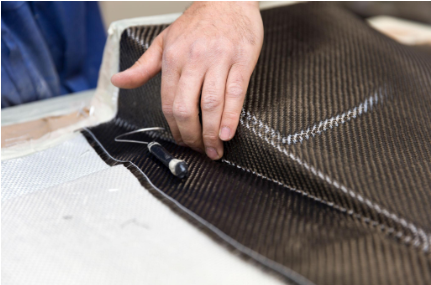
During the layup and curing stage, carbon fiber sheets are cut, oriented, infused with resin, and cured under controlled heat and pressure, as per the design. In-house control ensures precise fiber alignment, low void content, and strong layer bonds.
By controlling layup and curing, companies reduce defects and ensure consistent stiffness, tensile strength, and fatigue resistance. For mission-critical applications, these properties are non-negotiable.
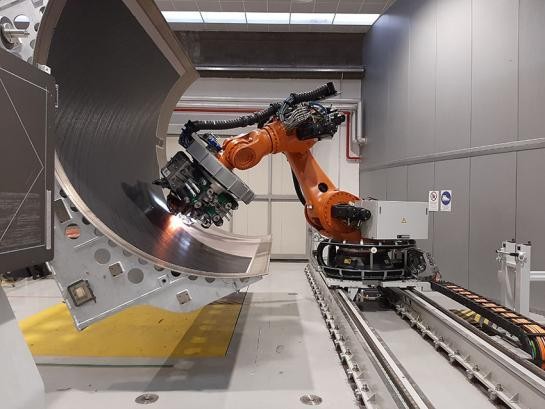
Vertical integration also enables innovative layup techniques. Manufacturers can tailor fiber orientation to reinforce areas subjected to high stress, improve impact resistance, or optimize weight distribution.
This flexibility is far more limited when outsourcing layup or curing to external suppliers, making integrated production a competitive advantage in advanced engineering applications.
Machining and Precision Fabrication
After curing, carbon fiber parts undergo precision machining and fabrication in-house using advanced CNC machines that prevent cracks and delamination.
Internal control of machining maintains dimensional accuracy and integrity. Mounting points for robotics, tools, or aerospace fixtures must meet precise tolerances, and in-house machining reduces variability and delays, ensuring each component fits its assembly.
Assembly and Final Product Testing
The final stage of vertical integration is assembly and testing. Once individual carbon fiber components are manufactured and machines. They are assembled into their respective final products for example, tactical bolt cutters, robotic arms, or wind turbine blades.
In-house assembly ensures each product’s components align correctly, fasteners and adhesives are properly applied, and the entire assembly meets performance specifications before leaving the factory.
Testing in a vertically integrated facility includes mechanical load testing, fatigue testing, and environmental exposure simulations. Products are evaluated for strength, durability, vibration resistance, and operational efficiency.
Any issues identified during testing can be traced back to specific stages of production, allowing engineers to implement corrective actions immediately. This closed-loop production and testing system ensures that every final product is consistent, reliable, and mission-ready.
Benefits of Vertical Integration
Vertical integration provides several key advantages for advanced manufacturing:
- Consistent Quality: By controlling every stage from raw materials to final assembly, manufacturers reduce variability and maintain consistent mechanical properties.
- Faster Development Cycles: Close collaboration between engineering and production teams accelerates prototyping, testing, and iterative improvements.
- Cost Efficiency: Reducing reliance on third-party suppliers lowers transportation, handling, and coordination costs while minimizing defects.
- Enhanced Reliability: Integrated testing and quality control ensure mission-critical performance in extreme environments, from military operations to renewable energy systems.
- Design Flexibility: Internal control allows for advanced fiber orientation, layup patterns, and complex geometries that would be difficult with outsourced processes.
Applications in Tactical and Industrial Settings
Vertical integration plays a key role in industries where performance cannot be compromised:
- Military & Tactical Tools: Carbon fiber bolt cutters, breaching tools, and gear kits benefit from integrated manufacturing to ensure high-strength, lightweight, and reliable operation.
- Robotics & Automation: Arm components, load-bearing frames, and precision manipulators rely on vertically integrated carbon fiber production for stiffness, fatigue resistance, and accurate tolerances.
- Renewable Energy Systems: Wind turbine blades and solar panel structures require consistent material performance and durability over decades, achievable through integrated layup, curing, and assembly.
Controlling every stage enables manufacturers to deliver products that are stronger, lighter, and more reliable than those made through fragmented processes.
Conclusion
Vertical integration is more than a production strategy; it is a performance enabler. In carbon fiber manufacturing, controlling every step from raw material sourcing to final assembly ensures superior quality, reliability, and efficiency.
For mission-critical tools, robotic systems, and renewable energy structures, vertical integration guarantees consistent mechanical properties, reduced defects, and faster development cycles.
Companies that leverage vertical integration can innovate more rapidly, deliver products that meet demanding specifications, and provide end-users with tools and components they can depend on in the field.
Experience the advantages of vertically integrated carbon fiber manufacturing that ensures consistency, precision, and full production control. Contact our team today to learn how integrated processes improve quality and performance from start to finish.