
Industrial systems are under constant pressure to move faster while maintaining precision, consistency, and reliability. As automation systems, robotics platforms, and production equipment become more advanced, machine speed is no longer limited only by software or motor performance. Structural design plays a major role in determining how efficiently a system can accelerate, operate continuously, and maintain control under demanding conditions.
Traditional materials can add unnecessary mass to moving systems, increasing the load placed on motors, actuators, bearings, and support structures. As machine speeds increase, this additional weight can reduce responsiveness, increase vibration, and place greater stress on mechanical components. Over time, these factors can affect consistency, operational efficiency, and long-term system performance.
Composite materials such as carbon fiber help address these challenges by reducing structural weight while maintaining strength and rigidity. In many industrial environments, lightweight composite components support faster motion control, smoother acceleration, and improved operational responsiveness without compromising structural integrity.
Request a consultation to explore how carbon fiber components can support faster industrial machine speeds. This gives your team an opportunity to assess integration, structural performance, and long-term operational benefits before implementation.
Increasing machine speed is not simply a matter of adding more power. As systems move faster, structural performance becomes increasingly important.
Machine speed is directly affected by:
When systems carry excessive weight, motors and actuators must work harder to move components through each cycle. This can reduce efficiency and increase wear across the system.
Lighter structural components help reduce this burden, allowing systems to operate with greater responsiveness and smoother motion characteristics.
Composite materials offer a high strength-to-weight ratio, making them useful in applications where motion speed and control are closely linked.
Reducing unnecessary structural mass helps industrial systems:
In automation and robotics systems, this improved responsiveness can support higher throughput while helping maintain motion consistency across repeated operations.
As machine speeds increase, vibration becomes a larger operational concern. Even small amounts of structural deflection can affect positioning accuracy, alignment consistency, and overall system stability.
Composite materials can help reduce vibration due to their stiffness and damping properties. Carbon fiber structures, in particular, are often used in precision industrial systems where vibration control is critical to maintaining reliable performance.
Reducing vibration may support:
This becomes especially important in systems operating continuously or at high cycle rates.
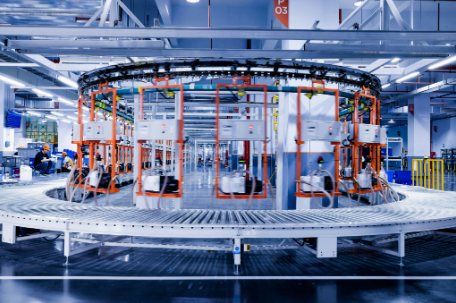
In industrial automation environments, small improvements in acceleration and motion efficiency can influence overall production throughput.
Lighter composite structures may support:
Because motors and actuators move less weight, systems can achieve faster motion profiles while reducing unnecessary mechanical strain.
This can improve operational efficiency without requiring major increases in system size or power demand.
Reducing weight alone is not enough. Industrial systems still require structural rigidity to maintain alignment, control, and repeatable performance under continuous use.
Composite materials are valuable because they combine lightweight properties with strong structural performance. Properly engineered composite components can maintain dimensional stability while supporting demanding motion environments.
This balance helps systems:
In precision manufacturing and automated equipment, maintaining this balance between weight reduction and rigidity is critical.
Composite materials are widely used in advanced engineering because they provide high strength while significantly reducing overall system weight. This combination allows industrial machinery to operate at higher speeds with improved stability and energy efficiency.
Composite materials are used across a wide range of industrial systems where motion efficiency and structural performance are closely connected.
Examples include:
In these environments, lightweight structural components improve responsiveness while supporting reliable operation under repeated motion.
Heavier systems place greater loads on moving mechanical components over time. Bearings, actuators, rails, motors, and support structures may experience increased wear when repeatedly accelerating and decelerating larger masses.
Reducing unnecessary weight can help lower stress across the system, potentially improving:
This is one reason why lightweight composite structures are often considered in systems designed for long production cycles or continuous industrial use.
Material selection influences far more than structural strength. It affects how a machine responds to movement, handles vibration, maintains alignment, and performs across repeated operational cycles.
Organizations such as the American Composites Manufacturers Association (ACMA) continue to highlight the role of advanced composite materials in improving performance across industrial and manufacturing applications.
Choosing the right composite structure depends on:
The goal is not simply to reduce weight. It is to improve the entire system’s performance under real operating conditions.
Composite Manufacturing Inc. (CMI) develops carbon fiber and composite components for industrial environments where lightweight performance, rigidity, and operational reliability are important.
Our team supports projects requiring:
Each application is evaluated based on the operational requirements of the system, helping ensure composite structures support both performance and long-term usability.
As industrial systems continue pushing toward higher speeds and greater operational efficiency, structural performance becomes increasingly important. Lightweight composite materials help support faster motion, improved responsiveness, and more stable system behavior across demanding environments.
Contact Composite Manufacturing Inc. to discuss carbon fiber and composite solutions designed for industrial systems, automation platforms, and precision equipment applications.