Two carbon fiber parts can share the same drawing and still differ significantly in performance, cost, and scalability. depending on how they are molded. The process determines how fiber and resin are combined, how much pressure consolidates the laminate, how long each cycle takes, and what tooling the program needs. Choosing it is one of the first engineering decisions in a composite program, and one of the hardest to change once tooling is built. CMI works across several molding processes in-house, which lets us select the process for the part rather than the equipment a supplier happens to have.
Not sure which process fits your part?
CMI’s engineering team can review your geometry, performance requirements, and production volumes.
The Main Processes and What Sets Them Apart
Prepreg Layup With Autoclave Cure
Prepreg materials arrive with fiber already impregnated with resin and are laid up in a mold before cure. In an autoclave, the part is cured under both heat and pressure. TWI, the engineering research organization, notes that autoclave processing gives less porosity and superior mechanical properties, but requires a slow cycle time and expensive equipment, particularly for large components (TWI). CompositesWorld similarly notes that autoclaves are generally expensive to buy and operate (CompositesWorld).
Out-of-Autoclave Prepreg
Out-of-autoclave (OOA) prepregs are designed to cure under vacuum bag pressure in an oven rather than in an autoclave. CompositesWorld describes OOA processing as less capital-intensive and less expensive to operate than an autoclave (CompositesWorld). A peer-reviewed review of OOA prepregs explains that these materials rely on specific microstructural features to achieve low porosity and tight dimensional tolerances, and that successful cure depends on selecting appropriate material properties and process parameters (Centea et al., 2015). In other words, OOA can work well, but it is less forgiving of material and process choices.
Resin Transfer Molding and Vacuum Infusion
In resin transfer molding (RTM), a dry fiber preform or fabric is placed in a heated mold, and reactive resin is injected into the mold under pressure (TWI). In vacuum infusion, vacuum draws a low-viscosity resin through a dry fibrous preform (TWI). Both start from dry reinforcement rather than prepreg, which changes how fiber placement, resin content, and tooling are planned.
Compression Molding
In compression molding, a charge of fiber and resin is placed in a preheated mold, which is then closed and held under pressure until the resin cures (TWI). CMI uses compression molding for repeatable production volumes, and its hard tooling is designed to produce thousands of parts with consistent quality.
How CMI Works Across These Processes
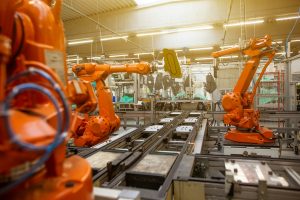
CMI’s manufacturing process includes prepreg layup with autoclave or out-of-autoclave cure, resin transfer molding and vacuum infusion, compression molding for repeatable production volumes, and CNC trimming and machining for tight tolerances. CMI’s pre-production capabilities also include extreme pressure molding and composite layup and assembly. CMI works with a broad range of carbon fiber prepregs, dry fabrics, resins, cores, and adhesives, and process parameters stay locked and monitored during cure cycles. See how these processes fit into the full production flow on CMI’s manufacturing and assembly page.
How to Narrow the Choice
There is no single best process. The right one depends on how a part’s requirements align with each process’s tradeoffs. The factors that usually drive the decision include:
- Structural and quality requirements, including how much porosity the application can tolerate
- Part size and geometry, including thickness changes, undercuts, and molded-in features
- Production volume and the cycle time needed to support it
- Tooling budget and how long the tooling must last
- Surface finish requirements on one or both sides of the part
- Metal inserts or hardware that must be molded in or added after cure
These factors interact. A process that suits a few prototype units may not be the most practical choice at production volume, and a process chosen for cycle time may require tooling that is not justified for a low-volume program. Working through them with the team that will design the tooling and run production avoids choosing a process that has to be changed later. CMI’s in-house design and engineering team reviews these inputs at the start of a program.
Process Choice Shapes Tooling
Each molding process places different demands on the mold: the pressure it must withstand, how it is heated, how resin enters or is contained, and how many cycles it must survive. That is why process selection and tooling design need to happen together. CMI builds tooling in-house from aluminum, steel, or composite tooling materials depending on the program, and can integrate vacuum or heating features when required. Learn more about CMI’s tooling and mold development process, and how co-molding carbon fiber with metal can bring hardware into the molded part.
Choosing the process early, with input from the people who will build the tooling and run production, is what keeps a composite program from redesigning around a process decision that no longer fits. Explore CMI’s full composite solutions to see how process selection connects to engineering, tooling, and production.
Choose the process before you commit to tooling.
Contact CMI’s engineering team to compare molding options for your part.