
A surgical robotic platform’s clinical positioning accuracy depends on decisions made at the component level. When structural materials at the distal end of a robotic arm add inertial mass, proximal actuators must handle a larger effective load to maintain precision. When end effector frames deflect under surgical forces, the kinematic chain loses the stability the application demands. The material choices made during component design determine whether a platform achieves the precision its clinical application requires — and carbon fiber composite addresses the combination of requirements that no single alternative material meets.
Engineering composite components for a surgical robotics program?
CMI’s team works with medical device OEMs on robotic arm structures, end effectors, and imaging-compatible assemblies.
Why Inertial Mass at the Distal End Matters More Than Mass at the Base
In a multi-link robotic arm, mass at the distal end forces the proximal actuators to handle a larger effective load. The farther a mass is from the actuator, the greater the torque required to move it precisely, and the more the actuator’s resolution is consumed by managing that load rather than executing fine positioning. Reducing distal mass lowers the torque demand for precise positioning and allows finer resolution without requiring larger or more powerful actuators.
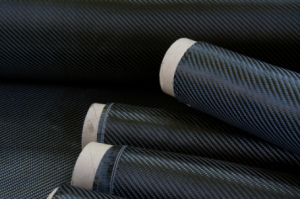
Carbon fiber composites offer a significantly better stiffness-to-weight ratio than aluminum and titanium for this application. It delivers the structural rigidity needed to maintain dimensional stability under surgical loads while contributing far less inertial mass than metal alternatives. For robotic platforms where positioning accuracy is measured in fractions of a millimeter, the material choice at the end effector is not incidental. It directly affects the system’s clinical performance. CMI’s custom composite engineering approach addresses this at the design stage, optimizing fiber orientation and laminate architecture specifically for the load cases and dimensional requirements of robotic arm components.
End Effector Frames: Stiffness, Low Mass, and Radiolucency in One Material System
End effector frames for surgical robotic platforms need to satisfy three structural requirements simultaneously in imaging-guided surgical applications. Stiffness keeps the instrument’s position stable relative to the kinematic chain under the forces of surgical interaction. Low mass reduces wrist actuator demands and allows higher dynamic bandwidth. Radiolucency can help reduce imaging interference in applications involving CT and fluoroscopy, while MRI compatibility depends on additional material properties and device-specific considerations. Carbon fiber composites may be suitable for certain applications across these environments, depending on the material system, component design, and imaging requirements.
Aluminum provides low mass but introduces imaging artifacts in radiolucency-critical applications and offers lower stiffness-to-weight performance than carbon fiber. Titanium provides good stiffness but adds mass and creates imaging artifacts. Carbon fiber’s combination of high specific stiffness, low density, and inherent radiolucency—when designed correctly—eliminates the trade-offs required by metal alternatives. CMI’s surgical table accessories demonstrate the same design philosophy applied to patient-contact imaging components: the material system is engineered to produce no meaningful artifact across fluoroscopy, CBCT, and standard radiography.
What Medical Device OEMs Need From a Composite Supplier for Robotics Programs
Qualifying a composite supplier for a surgical robotics program involves more than confirming the supplier can fabricate carbon fiber parts. The documentation, quality system, and engineering continuity requirements for regulated medical programs are specific, and a supplier that does not operate under them creates program risk that is difficult to resolve late in development.
The supplier qualifications that matter for robotics programs include:
- FDA registration and an ISO 13485-compliant quality system covering design controls, process validation, and documentation
- Lot-level material traceability for every production unit
- Process validation demonstrating consistent conforming output
- Support for design history file documentation from program intake
- Co-molding capability to join carbon fiber structural members with metal robotic joint interfaces
CMI has operated under FDA registration for over 40 years. Its quality system aligns with the FDA’s Quality Management System Regulation (QMSR), effective February 2, 2026, and its ISO 13485-compliant processes cover the design controls, process validation, and documentation that regulated robotics programs require. CMI’s co-molding carbon fiber with metal capability is directly applicable to robotic joint interfaces, where carbon fiber structural members must be joined to metal actuation components with precise dimensional and load transfer requirements.
Pre-Production Validation for Robotic Components
Robotic arm and end effector components have tight dimensional tolerances and load-path requirements that make the pre-production stage critical. A part that passes prototype inspection does not guarantee production conformance — the tooling, process, and inspection criteria that govern production must be validated before production resources are committed. For regulated medical programs, that validation must be documented to support the design history file.
CMI’s pre-production sample fabrication process uses production tooling and documented process parameters from the start, so the sample is evidence of production capability rather than a one-time demonstration. The documentation delivered with each pre-production sample — dimensional records, material certifications, cure cycle records, nondestructive inspection results when required — provides the process validation evidence that production approval requires. For programs with co-molded metal interfaces, pre-production validation covers the complete assembly, not just the composite component. See CMI’s composite manufacturing and assembly process for more on how production quality is maintained from first unit through program lifecycle.
Q4 Is Active Supplier Qualification Time for Next-Year Launches
OEMs planning surgical robotics launches in the following year typically run supplier qualification in Q4. The qualification process includes documentation review, audit scheduling, first-article production, and validation testing — activities that take longer than program teams often budget when they begin planning. Starting supplier qualification in Q1, after the new year begins, compresses production timelines and creates schedule risk that is difficult to recover from without impacting the launch date.
Engaging CMI’s engineering team now, while Q4 qualification timelines are still workable, allows documentation review, first-article production, and validation to proceed at a pace that supports a next-year launch rather than threatening it. The performance requirements of surgical robotics programs—tight tolerances, inertial mass optimization, radiolucency, and regulated documentation—are requirements CMI has been engineering to for over four decades. Contact CMI through the contact page to discuss your program timeline and what qualification will require. Review CMI’s composite solutions for a full picture of the capabilities available to support your robotics program.
Q4 is supplier qualification time for next-year launches. Start the conversation now.
CMI’s engineering team works with surgical robotics OEMs on component design, qualification, and validated production.