
Carbon fiber shows up across the operating room in armboards, hand tables, positioning frames, and imaging accessories, because it is light, stiff, and radiolucent. Most of these products are reusable. Between every case, they are cleaned and disinfected, and some are sterilized. For a medical device OEM, that means the cleaning and sterilization instructions are part of the product, and the composite has to hold up to them for its whole service life. This post walks through what FDA expects from reprocessing instructions and how those expectations should shape a carbon fiber design from the start.
Developing a reusable carbon fiber device?
CMI is FDA-registered and operates an ISO 13485-compliant quality system. Talk with our engineers early in design.
What FDA Expects From Reprocessing Instructions
FDA’s guidance, Reprocessing Medical Devices in Health Care Settings: Validation Methods and Labeling, sets out six criteria for reprocessing instructions in device labeling. Instructions should reflect the device’s intended use, tell users to thoroughly clean the device, name the appropriate microbicidal process, be technically feasible, be comprehensive, and be understandable (FDA).
The required level of microbicidal processing depends on how the device contacts the patient. The guidance uses three categories (FDA guidance):
- Critical devices contact the bloodstream or normally sterile tissue, and should be cleaned and sterilized after each use.
- Semi-critical devices contact intact mucous membranes or non-intact skin, and should be cleaned and then sterilized, or high-level disinfected if sterilization is not possible.
- Non-critical devices contact only intact skin, and FDA recommends thorough cleaning followed by intermediate- or low-level disinfection.
Many patient positioning accessories fall into the non-critical group, but the classification belongs to the device manufacturer and depends on the intended use. A device that is sometimes draped into the sterile field may need a different process than one that only touches a padded armrest.
Material Compatibility Is a Design Requirement
The guidance is explicit that compatibility has to be proven, not assumed. It says the compatibility of the device with the cleaning and microbicidal methods must be validated, that labeled cleaning agents should be ones “demonstrated to be compatible with the device,” and that if a product or class of products can damage the device’s materials, the labeling should warn against it (FDA guidance).
For a carbon fiber device, that compatibility question covers the whole assembly, not just the laminate:
- The resin system and any surface coating or clear coat
- Adhesives and bonded joints
- Metal inserts, latches, and fasteners
- Pads, foams, and covers
- Labels and markings
Any of these can be the weak point under repeated exposure to disinfectants, heat, or moisture. For heat in particular, FAA guidance on composite structure notes that the glass transition temperature of most composite materials is further reduced by moisture absorption (FAA AC 20-107B), which is one reason resin selection should account for the device’s reprocessing conditions from the start.
Validate Across the Device’s Reuse Life
A device that survives one cleaning cycle may not survive repeated reprocessing across its labeled reuse life. FDA’s guidance says labeling should tell users how many times a device can be reused based on testing, or otherwise give them a way to judge when it is no longer fit for use, and that validation studies should incorporate multiple full use cycles (FDA guidance). For a composite device, testing can reveal changes such as surface degradation, bond weakening, or loss of stiffness after repeated reprocessing.
Design Features That Make Cleaning Harder
FDA encourages manufacturers to “consider device designs that facilitate easy and effective cleaning,” starting from the earliest stages of design (FDA guidance). The guidance names features that complicate cleaning, including fine channels, seals, and mated articulating surfaces, and warns that some devices have unsealed seams or crevices through which excess liquid disinfectant could reach the interior. For carbon fiber devices, design reviews should look closely at:
- Seams and edges where a laminate meets a metal insert or bonded part
- Trimmed or machined edges, and whether they are sealed
- Hinges, clamps, and latching mechanisms
- Pockets or recesses where fluid can pool
- Pad attachment methods that trap fluid underneath
FDA also notes that design or material changes that could affect sterilant penetration or potency may require revalidation (FDA guidance). Settling the material stack and joint design before validation begins may avoid repeating that work.
How CMI Supports Medical OEMs
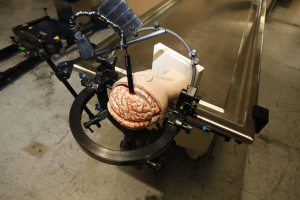
CMI has decades of experience applying composite materials to medical, surgical, and imaging equipment, and makes its own line of surgical table accessories. CMI is FDA-registered and operates an ISO 13485-compliant quality system. Its engineering team handles material selection, layup design, and design for assembly and service using CAD/CAM, FEA, and prototypes, and its verification work includes lifecycle testing. CMI also co-molds metal inserts into composite parts and records lot numbers and cure histories. These records support material traceability for each component.
The reprocessing instructions, their validation, and the device classification remain the device manufacturer’s responsibility. A composite manufacturer’s role is to help design and build a part that can meet them. To learn more about what OEMs should look for in that partner, read how medical OEMs evaluate composite manufacturing partners.
Plan for reprocessing before the first prototype.
Talk with CMI about materials and design for your reusable carbon fiber device.