

Clinical and procurement teams specifying radiolucent OR accessories are not, in most cases, materials engineers. They are working from a product category label and a set of assumptions about what that label confirms. Some of those assumptions hold up. Several do not — and the ones that do not tend to produce misorders, workflow friction, and equipment that underperforms in the imaging environment it was purchased to support.
This post covers the misconceptions that come up most often in conversations with clinical and procurement buyers evaluating products like CMI’s surgical table accessories, NekSpine, and other radiolucent carbon fiber components for imaging-adjacent surgical environments.
Radiolucency describes a material’s transparency to ionizing radiation — specifically X-ray energy, which includes fluoroscopy and CT. Carbon fiber composite attenuates the X-ray beam significantly less than aluminum or steel, which is why it is widely used in fluoroscopic and CT-adjacent OR accessories.
Radiolucency does not describe MRI compatibility. MRI uses magnetic fields and radiofrequency energy, not ionizing radiation. A carbon fiber component that is radiolucent under fluoroscopy may not be appropriate for an MRI environment if its construction includes ferromagnetic hardware or geometry that introduces field distortion near the scanner bore. MRI compatibility is governed by standards including ASTM F2503 and requires separate, explicit confirmation from the manufacturer — it is not implied by radiolucency. The FDA’s medical device regulatory framework addresses labeling requirements for MR Safe, MR Conditional, and MR Unsafe classifications.
The degree to which a carbon fiber composite attenuates imaging energy depends on its thickness, fiber volume fraction, resin content, and the presence or absence of non-carbon-fiber elements in the assembly. A carbon fiber accessory with stainless steel attachment hardware may introduce localized artifact at the hardware locations even if the carbon fiber structure itself produces minimal attenuation.
For imaging-critical applications, the relevant question is not only whether the product is made from carbon fiber — it is whether the entire assembly, including hardware and mounting components, keeps the primary beam path clear for the imaging angles used in the intended procedures. CMI’s UM3 Universal Modular Mount is an example of a system designed with imaging field considerations built into the mounting configuration.
Radiolucent OR accessories must physically attach to the surgical table in use. Surgical table rail standards vary by manufacturer and model. An accessory that mounts correctly to one table may not mount to another. Confirming table compatibility requires knowing the table manufacturer, model, and rail standard — and confirming with the accessory manufacturer that their mounting hardware matches. This is a pre-purchase step, not a receiving step.
Carbon fiber is a high-performance structural material, but structural performance in any specific application depends on the laminate design — fiber orientation, ply count, resin system — and the component geometry. A carbon fiber patient positioning accessory rated for a given load in its standard configuration may not be equally adequate in an off-label configuration or at the upper range of the rated capacity. CMI’s in-house design and engineering team works with program teams to evaluate structural requirements for specific use configurations.
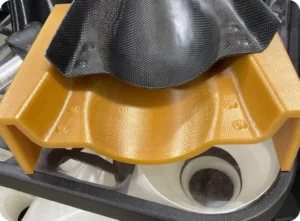
For accessories used as part of an FDA-cleared medical device system, regulatory clearance is device-specific. A radiolucent carbon fiber accessory that carries its own 510(k) clearance as a standalone product may not be cleared for use as a component of a specific cleared device system. Procurement teams specifying accessories for cleared device systems should confirm that the accessory is appropriate and cleared for use with the specific system. CMI’s medical device composite manufacturing capability— FDA-registered and ISO 13485 compliant—is built to support the documentation requirements of regulated programs.
An accurate specification for a radiolucent OR accessory answers: compatible with which imaging modalities (confirmed by the manufacturer), compatible with which surgical table rail standard (confirmed against your specific table), structurally adequate for which patient load in which configuration (confirmed against manufacturer ratings),compatible with the required cleaning, disinfection, or sterilization method, (confirmed for your facility’s sterilization process), and regulatory status confirmed for the intended application and device system. CMI’s custom composite engineering capability supports programs with requirements that standard products do not fully address.