

The medical device supplier relationship is one of the highest-stakes vendor decisions an OEM makes, and it is frequently made on the basis of the least reliable information: a supplier’s own capability statements, a tour of a clean facility, and a competitive quote. None of those inputs answer the questions that determine whether a regulated composite program will run cleanly, document correctly, and pass an audit. Those answers require a different set of questions asked at the beginning of the evaluation rather than after the first article fails or the qualification audit finds a process gap.
The supplier who wins the quote and the supplier who can actually support a regulated build-to-specification program are not always the same organization, and the cost of discovering that difference after tooling commitment is substantially higher than the cost of the evaluation that would have surfaced it in advance. Contact our engineering team via our contact page to discuss the evaluation process for your specific medical program.
ISO 13485 certification confirms that a quality management system exists and meets defined structural requirements. It does not confirm that the system produces consistent, traceable outcomes at the part level for the specific program type you are qualifying. The questions that reveal actual quality discipline go one level deeper than certification status. Specifically, regulated medical OEMs evaluating composite suppliers should ask how design controls govern the transition from customer drawing to production tooling, how process validation is structured and what the deliverables are, how material lot traceability is implemented and retrieved, what the nonconformance process looks like and how dispositioned parts are tracked, and whether the documentation package the supplier produces is structured to support a design history file for a cleared medical device.
Suppliers who answer these questions specifically and consistently have built quality systems that align with the actual requirements of regulated programs. Suppliers who answer in general terms or point to their certificate without describing the underlying practices have built quality systems around certification audits. Our FDA-registered manufacturing page describes how our quality system is structured specifically for medical programs.
Process validation is the activity used to demonstrate that a manufacturing process can consistently produce conforming output within defined parameters. Rather than focusing only on a first article review, validation evaluates whether the process remains capable and reliable across production runs throughout the life of a program. Specifically for composite manufacturing, the process parameters that require validation include cure cycle definition and control, layup sequence documentation, material handling and storage requirements, secondary operation procedures, and inspection checkpoints and acceptance criteria.
A supplier whose production depends on experienced technicians’ judgment rather than documented and validated process parameters is a supplier whose output varies with technician availability, and that variation is invisible in a first-article review. The evaluation question that surfaces this distinction is specific: show me a process validation package for a program comparable in complexity to mine. The answer to that request tells you more about a supplier’s regulated program capability than their facility tour will. Our composite manufacturing and assembly page describes how our process controls are structured across medical production programs.
Tooling ownership is one of the most consequential yet least frequently examined questions in supplier evaluations for medical OEMs. A supplier that fabricates tooling in-house under documented controls, maintains it as a program asset with condition records, and manages modifications through a formal change control process is a fundamentally different situation from a supplier that outsources tooling to a third party. In-house tooling fabrication allows the engineering team responsible for part design to work more closely with the team developing the tool. This collaboration can help identify and address dimensional considerations earlier in the process while supporting a more efficient feedback loop when modifications are required.
It also means tooling condition is managed within the supplier’s quality system rather than as a separate vendor relationship that the OEM has no visibility into. For medical programs where tooling changes require careful documentation and regulatory consideration, in-house tooling management can support stronger process control and visibility throughout the change management lifecycle. Our in-house design and engineering page describes our tooling development and management capabilities.
The documentation requirements for a regulated medical composite program are sufficiently specific that confirming them during supplier selection is significantly more effective than negotiating them after production begins. The documentation a medical OEM should confirm that their composite supplier can deliver includes material certifications and lot traceability records for every material in every production unit, cure cycle records tied to individual production lots, dimensional inspection records for critical features, nondestructive inspection results for structural components, process deviation and nonconformance records with disposition documentation, and a documentation structure that supports design history file assembly for cleared devices.
Suppliers who treat documentation as a program deliverable from the beginning of a project can help create more organized and traceable records, which may support smoother preparation of regulatory submissions compared with assembling documentation after production activities are complete. The documentation expectations for our medical programs are discussed at program intake rather than addressed after the fact. Contact our engineering team through our contact page to discuss documentation requirements for your specific program.
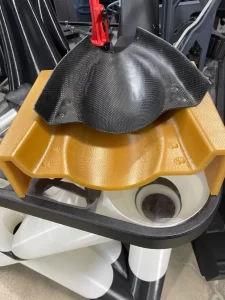
Medical OEMs conducting composite supplier qualification for regulated programs should evaluate against the following criteria, structured by the phase of the program they most directly affect:
Programs that evaluate suppliers against these criteria before making a commitment may be better positioned for long-term success than those that focus primarily on factors such as price and lead time. A downloadable supplier evaluation scorecard for regulated composite programs is available through our contact page, and our engineering team is available to discuss how CMI addresses each criterion for your specific program type.
Show me a process validation package for a medical program comparable in complexity to mine. The answer to that request reveals more about a supplier’s regulated program capability than any capability statement, facility tour, or quality certificate.
It confirms that a quality management system exists and meets defined structural requirements. It does not confirm that the system produces consistent, traceable outcomes at the part level for the specific program type you are qualifying. The questions that reveal actual quality discipline go beyond certification status to the specific implementation of process validation, traceability, and nonconformance handling.
Yes, for programs of sufficient scale. A facility visit reveals the actual condition of equipment, the depth of process documentation, and the team’s ability to discuss their process specifically and consistently, in ways that a capabilities document or a phone call cannot communicate. Contact our team through our contact page to arrange a facility visit.
Ask specifically whether tooling is fabricated in-house or outsourced, how tooling condition is monitored over the production life of a program, how tooling modifications are handled through the change control process, and who owns the tooling asset and under what terms. The answers reveal whether tooling is managed as a program asset within a documented quality system or as a one-time deliverable with no ongoing oversight.
At minimum: material certifications and lot traceability records, cure cycle documentation tied to production lots, dimensional inspection records for critical features, nondestructive inspection results for structural components, and nonconformance records with disposition documentation. For cleared device programs, the documentation should be structured to support the assembly of the design history file. Confirm these requirements at supplier selection rather than requesting them after production is complete.
Ask the supplier to describe how their documentation package is structured for a cleared medical device program and what their experience is with DHF assembly specifically. Suppliers who have supported regulatory submissions describe the process specifically. Suppliers who have not tend to describe their general documentation capabilities without connecting them to the regulatory context the program requires. Contact our engineering team through our contact page to discuss our experience with regulated medical programs.
The biggest risk is discovering the capability gap after tooling is committed and first-article production has begun, at which point the cost of switching suppliers includes tooling write-off, production restart, and potential regulatory requalification for the manufacturing change. The evaluation effort required to identify potential capability gaps before commitment can help prevent more significant challenges later in the program lifecycle.
Contact our engineering team via our contact page or call to begin a conversation about your program requirements, regulatory context, and the intake and qualification process for your specific situation.
Medical composite supplier qualification is not a bureaucratic exercise. It is the mechanism that determines whether a regulated program runs cleanly or accumulates the documentation gaps, process deviations, and compliance risks that surface at audit or at first article production. The criteria that predict long-term program performance are knowable before commitment, and the suppliers who perform well against them are distinguishable from the ones who will not, if you ask the right questions at the right stage of the evaluation. Our engineering team has supported regulated medical composite programs for more than forty years and is available to discuss how CMI addresses each evaluation criterion for your specific program. Contact us through our contact page to begin that conversation, or review our FDA-registered manufacturing capabilities on our medical manufacturing page and our composite manufacturing and assembly page.