
Most engineers pick a material before they pick a manufacturer, and that order of operations is exactly backward. By the time a manufacturing partner is in the room, the weight, cost, and performance ceiling of the entire program have already been locked in by a decision made using a generic strength chart rather than the actual application requirements.
A direct comparison across strength-to-weight ratio, thermal performance, corrosion resistance, and cost gives engineers a faster path to the right material choice before tooling begins.
This guide compares carbon fiber, aluminum, and steel across the criteria that matter most for structural component design.
Request a Material Selection Consultation with CMI’s Engineering Team. General comparisons can point you in the right direction, but the right material for your specific application depends on your actual weight, thermal, corrosion, and budget constraints. Talk with CMI’s team before you commit to a material so you’re making that decision with your real requirements in hand, not just a generic chart.
According to CMI’s published material performance data, carbon fiber offers up to 5x the strength of aluminum at roughly 33% of the weight, and up to 3x the strength of steel at roughly 20% of the weight. For applications where weight reduction directly affects performance, such as aerospace, medical equipment, and tactical gear, this ratio is the most significant material-selection advantage. For more on how this performs under real-world stress, see How Carbon Fiber Behaves Under Impact and Load Cycling.
Carbon fiber maintains reliable performance from -30°C to 300°C with extremely low thermal expansion. Aluminum and steel have higher thermal expansion coefficients, which can affect dimensional stability in components subject to wide temperature swings.
Carbon fiber is inherently corrosion-resistant and does not rust or degrade over time, unlike steel and untreated aluminum. As demonstrated in CMI’s own TRX® Bolt Cutters, built for environments where corrosion failure isn’t an option, this resistance holds up even under repeated exposure to salt water and moisture.
Carbon fiber tooling and material costs are typically higher upfront than aluminum or steel. The total cost comparison shifts when weight reduction, corrosion resistance, and reduced maintenance are factored across the product lifecycle.
Carbon fiber fits aerospace, medical equipment, tactical gear, and applications where weight matters most. Aluminum is well-suited to general structural applications with moderate weight sensitivity. Steel is well-suited to high-load applications where weight is not a primary constraint. For guidance specific to your application, CMI’s Custom Composite Engineering team can walk through the tradeoffs.
Both. Carbon fiber offers up to 5x the strength of aluminum at approximately 33% of the weight, meaning a carbon fiber component can match or exceed an aluminum part’s structural performance while weighing significantly less.
Carbon fiber offers up to 3x the strength of steel at approximately 20% of the weight.
Yes. Carbon fiber maintains reliable structural performance from -30°C to 300°C, with extremely low thermal expansion.
Upfront tooling and material costs are typically higher, but the lifecycle cost comparison often favors carbon fiber once weight reduction and reduced maintenance are factored in.
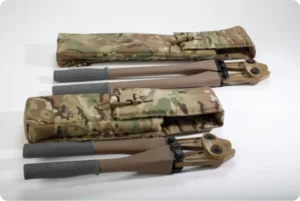
Corrosion-prone environments require ongoing maintenance or replacement for steel and untreated aluminum. Carbon fiber’s resistance eliminates that ongoing cost. See a real-world example in CMI’s TRX® Bolt Cutters.
Yes. Carbon fiber molding supports complex geometries that would otherwise require multi-step machining or assembly in metal.
Aerospace, medical devices, tactical equipment, and motorsports, where strength-to-weight and corrosion resistance directly address core requirements.
Yes, when weight isn’t a primary constraint, budget is highly cost-sensitive, or the geometry is simple enough that composite molding offers no advantage.
A manufacturing partner that reviews your actual requirements will provide a more accurate recommendation than a general comparison. Request a material selection consultation today.
Yes, including co-molding and hybrid assemblies. Learn about CMI’s co-molding capabilities today.
Request a Material Selection Consultation. Walk through your application’s specific weight, thermal, corrosion, and durability requirements with CMI’s engineering team before tooling and production planning begin, so the material decision you make today doesn’t become a costly redesign later.