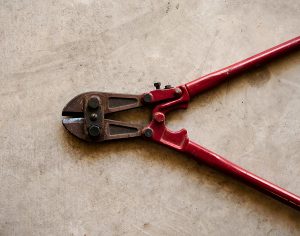
Traditional bolt cutters used in military operations are often heavy, slow, and prone to failure in extreme conditions. Soldiers need tools that can reliably cut hardened padlocks, chains, and rebar without adding fatigue or slowing missions.
The benefits of carbon fiber are its lightweight, strength, and reliability. Carbon fiber handles reduce operator strain and allow tools to be used over long missions without fatigue. Its stiffness and high strength deliver maximum cutting force efficiently, while ergonomic design improves leverage and comfort during repeated use.
The solution combines carbon fiber structural components with hardened 65 HRC steel jaws. The carbon fiber frame reduces weight and absorbs stress, while the steel jaws deliver precise, powerful cutting where it’s needed. This design ensures faster operation, less fatigue, and consistent, mission-ready performance even in the most demanding military conditions.
Explore the TRX® Bolt Cutter at Composite Manufacturing Inc with our lineup today to equip your team with lightweight, high-strength tools designed for demanding military and tactical operations.
The choice of materials is crucial. Carbon fiber is primarily used for handles and structural parts due to its strength-to-weight ratio, fatigue resistance, and corrosion protection, reducing mass without compromising durability.
The cutting jaws are made of hardened steel, specifically 65 HRC, ensuring efficient severing of locks, rebar, and chains. Combining carbon fiber handles and high-hardness steel jaws enables both lightweight operation and extreme cutting power.
Engineers also consider chemical resistance, ensuring cutters maintain performance when exposed to oils, solvents, or moisture. This material selection ensures durability and reliability for repeated military use.
Once materials are chosen, engineers focus on structural design. Carbon fiber components are layered and molded to strengthen stress-bearing areas. Finite Element Analysis (FEA) simulates load distribution, ensuring components perform predictably under extreme forces.
The load path is carefully engineered; carbon fiber handles efficiently carry force, and high-strength steel jaws convert leverage into cutting action. Geometry is optimized to reduce flex and maintain alignment throughout repeated cycles, ensuring reliability.
Prototypes undergo mechanical testing to measure cutting force, handle torque, jaw deflection, and endurance. Field trials by military personnel assess real-world performance and ergonomics.
Feedback guides refinements to handle angles, jaw alignment, and material thickness. Prototyping and testing continue until all requirements are met.
Scaling to production requires precise composite manufacturing. Carbon fiber sheets are laid and cured for consistent strength and stability. Steel jaws are machined and assembled to exact tolerances.
Vertical integration maintains quality from materials to assembly. Every cutter is tested for performance and ergonomic consistency before deployment to ensure compliance with military standards.
After production, the ongoing review continues. Units provide feedback from exercises and operations. Engineers track wear, pivot integrity, and jaw performance to recommend improvements.
This feedback loop drives ongoing improvements, ensuring reliability, reducing maintenance, and supporting mission success as needs evolve.
Tactical bolt cutters are used in a wide range of military applications:
Carbon fiber construction enables these tools to be carried in backpacks or vehicles, or mounted in kits, allowing operators to maintain mobility while carrying mission-critical equipment.
The combination of lightweight design and hardened jaws makes them uniquely suited for tactical environments where reliability and speed are essential.
While carbon fiber isn’t fully recyclable at scale, its long service life reduces the frequency of replacement and associated environmental impact.
Durable tools require fewer resources over time, reducing manufacturing emissions and minimizing waste. Military units benefit from lower long-term costs, and operators experience less downtime, all while maintaining mission readiness.
Carbon fiber enables complex shapes beyond those of metal, enabling ergonomic handles, compact folding designs, and precise jaw angles. Low weight improves speed, reduces fatigue, and allows use in specialized deployment kits.
The development of carbon fiber tactical bolt cutters demonstrates the combination of advanced material science, structural engineering, and practical military requirements. From defining functional requirements to prototyping, testing, and full-scale production, each stage ensures that the tool is lightweight, durable, and capable of meeting the extreme demands of tactical operations.
With carbon fiber and precision-engineered steel jaws, modern bolt cutters deliver reliable, efficient performance in every scenario. Contact our experts to learn how carbon fiber engineering can improve reliability, reduce operator fatigue, and deliver mission-ready performance in the field.