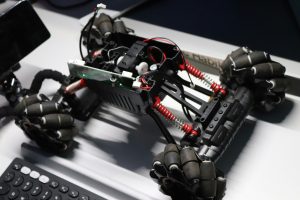
Carbon fiber has become one of the most widely adopted advanced materials in modern robotics and automation systems because of its exceptional lightweight properties, versatile design flexibility, and performance advantages over traditional metals.
Engineers across industrial automation, collaborative robotics, aerospace robotics, surgical robotics, and autonomous platforms continue to integrate carbon fiber into their systems because it offers a rare combination of low mass, high mechanical strength, and extremely predictable structural behavior.
As machinery becomes smaller, faster, and more complex, the demand for stronger yet lighter materials grows—and carbon fiber meets that need better than almost any other material currently available.
Looking to improve speed, precision, or payload capacity in your robotic systems?
Contact Composite Manufacturing Inc to explore carbon-fiber components engineered for high-performance automation.
One of the foundational reasons carbon fiber works so well in robotics is the nature of the raw materials used to produce it. Most carbon fibers are made from rayon, polyacrylonitrile (PAN), or pitch. These precursor materials undergo carbonization, which reorganizes the atomic structure into tightly aligned carbon crystals.
This alignment is what gives carbon fiber its exceptionally high stiffness-to-weight ratio and strength. Because these fibers can be woven into different orientations and embedded into a polymer matrix, engineers can mold carbon fiber into almost any structural form.
Unlike metal components that require machining or casting, carbon fiber composites can be laid up into complex shapes with variable thickness, tailored stiffness, and directional reinforcement.
This design freedom is particularly valuable in robotics, where components often need to be engineered around motors, sensors, wiring harnesses, actuators, and mounting hardware.
The combination of high mechanical strength, low thermal expansion, chemical resistance, and predictable stiffness makes carbon fiber exceptionally reliable in robotic systems that must remain stable across changing environmental conditions.
This is especially important in aerospace robotics and automated systems that must operate in fluctuating temperatures. Metals expand and contract significantly with temperature changes, which can introduce unwanted errors into sensitive robotic movements.
Carbon fiber expands only minimally, keeping precision components aligned and maintaining repeatability even in demanding environments.
Its chemical resistance also protects robotic assemblies from corrosion, moisture, solvents, and other industrial chemicals, helping maintain long-term performance.
Lightweight construction is one of the most critical requirements of modern robotics, and this is where carbon fiber provides some of its strongest advantages. Every single piece matters when designing robotic arms and systems.
Reducing structural weight allows motors to operate with lower requirements. This not only improves efficiency but also reduces the energy consumption of the system as a whole.
In aerial robotics, reduced weight directly leads to longer flight times, increased range, and greater payload capacity. For ground-based robots, lower weight results in faster movement, improved dexterity, and reduced wear on joints and mechanisms.
Because the material does not fatigue the same way metals do, robots built with carbon fiber can handle repetitive motions and cyclical stresses more effectively over long operational lifetimes.
This contributes to more reliable performance in high-duty-cycle environments such as warehouse automation, industrial sorting, pick-and-place robotics, and manufacturing lines.
Carbon fiber’s superior strength becomes even clearer when compared directly to materials such as steel and aluminum. Carbon fiber is approximately 20 percent lighter than steel and around 35 percent lighter than aluminum, while offering significantly higher stiffness.
This means engineers can design components that are not only lighter but also much stronger and more dimensionally stable. The result is reduced flex, less vibration, and higher precision in robotic movements.
In operations requiring micrometer-level accuracy, such as semiconductor manufacturing or robotic-assisted surgery, structural flex can introduce unacceptable errors. Carbon fiber’s rigidity ensures precise, repeatable motion.
Another major advantage is durability. Carbon fiber components require significantly less maintenance than many metal parts. Steel can rust or corrode, aluminum can crack under repeated stress, and both metals can deform under sustained load.
Carbon fiber resists corrosion, maintains stability under long-term mechanical cycling, and does not deform plastically in the way metals do.
This translates into lower maintenance costs, fewer component replacements, and longer machine life. Businesses benefit from reduced downtime, higher throughput, and greater confidence in mission-critical robotic systems.
In addition, carbon fiber’s vibration-damping properties help protect sensitive electronics, improve the performance of precision sensors, and stabilize robotic vision systems.
Because vibrations can degrade accuracy and shorten component lifespan, using materials that naturally dampen them improves overall reliability. The stiffness of carbon fiber also allows robotic systems to maintain structural integrity even during rapid dynamic motion, enabling faster cycle times without compromising accuracy.
Overall, carbon fiber is not simply a lightweight material; it is a performance-enabling material. It enhances speed, accuracy, efficiency, and long-term reliability in robotic and automated systems, making it an essential option for engineers who need to minimize mass without sacrificing strength.
As robotics continues to evolve toward smaller, faster, and more capable machines, carbon fiber will remain a foundational material supporting the next generation of technological innovation.
If you’re upgrading or designing next-generation robotic equipment, the right materials make all the difference. Reach out today to discuss carbon-fiber solutions that enhance durability and system efficiency.